
DataEyesAI OCR Document Parsing API: From "Recognition" to "Understanding"
DataEyesAI OCR Document Parsing API: From "Recognition" to "Understanding"
Have you ever encountered this predicament: receiving an important PDF contract or report, only to find that after using traditional OCR tools, you get chaotic text with no distinction between titles and body text, disordered tables, and no formatting—still requiring significant time for manual organization?
Please see the comparison below, which intuitively reveals the current state and future of document parsing:
Traditional OCR Output:
2024 Q1 Financial Report Core Performance Indicators Amount (10k CNY) YoY Growth Operating Revenue 15,280 +12.5% Net Profit 2,150 +8.3% See detailed analysis below...All content merged into one paragraph, structure completely lost
DataEyesAI OCR Parsing Result (Markdown Format):
# 2024 Q1 Financial Report
## I. Core Performance
| Indicator | Amount (10k CNY) | YoY Growth |
| :--- | :--- | :--- |
| Operating Revenue | 15,280 | +12.5% |
| Net Profit | 2,150 | +8.3% |
## II. Detailed Analysis
...
For this reason, DataEyesAI officially launches the next-generation OCR document parsing API. We break through the limitations of pure text recognition, integrating multimodal recognition and deep learning technologies to achieve high-precision text extraction while deeply parsing the document's layout structure and semantic logic. The core lies in directly outputting Markdown text that preserves complete formatting and hierarchical structure, transforming elements such as titles, tables, and lists into standardized, machine-readable data formats.
This means academic literature can be converted into searchable knowledge bases with one click, invoices and contracts can automatically extract data to connect with business systems, and complex reports can instantly become collaborative online documents. DataEyesAI OCR API is transforming dormant paper information into intelligent assets that drive business growth.
Technical Interpretation
The powerful performance of DataEyesAI OCR stems from an innovative "two-step" parsing strategy:
Step 1: Overall Planning, Rapid Positioning. The system first performs rapid scanning and analysis of the document layout, precisely framing all key elements such as text, tables, and formulas, and intelligently planning the correct order that conforms to human reading logic.
Step 2: Parallel Deep Reading, In-depth Recognition. Subsequently, the system sends these sorted content blocks in parallel to specialized high-precision recognition modules, focusing on parsing the specific text and semantic content of each section.
Finally, through a lightweight post-processing workflow, the system efficiently integrates the results from both stages and directly outputs structured Markdown and JSON data. This "layout first, recognition second" collaborative process ensures highly accurate and stable parsing results while achieving significant improvements in processing speed and resource efficiency.
How to Call the API
With just a few simple steps, you can access the OCR document parsing API on the DataEyesAI official website or use it directly online, quickly integrating technical capabilities into your business workflow.
Step 1: Log in to the Official Website and Obtain API Key
DataEyesAI Official Website: https://dataeyes.ai/
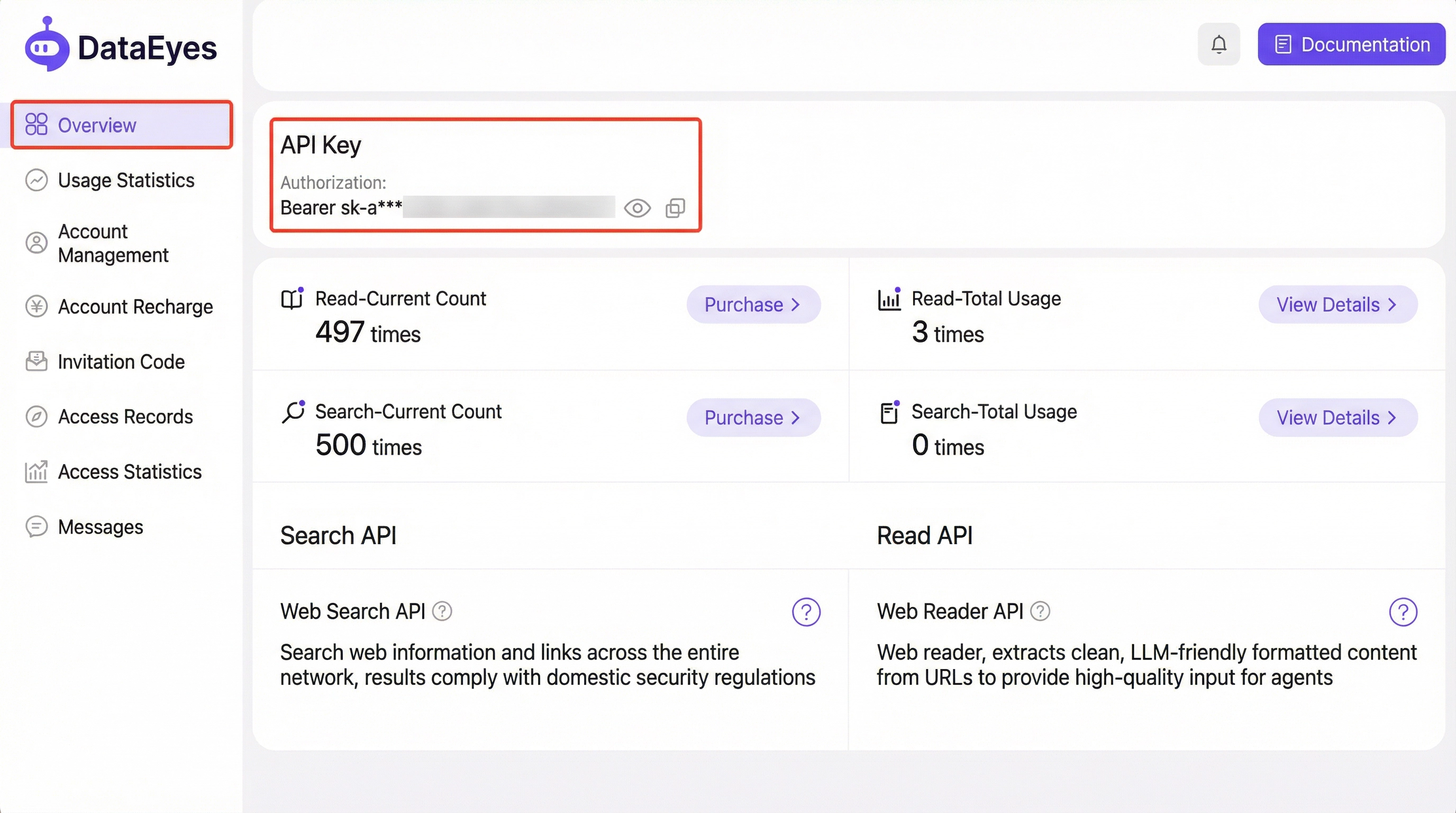
Visit the DataEyesAI official website, register and log in, then enter the console. On the "API Keys" page, you can create and obtain your exclusive API Key, which is the pass to call all services.
Step 2: Review Documentation, Integrate and Debug
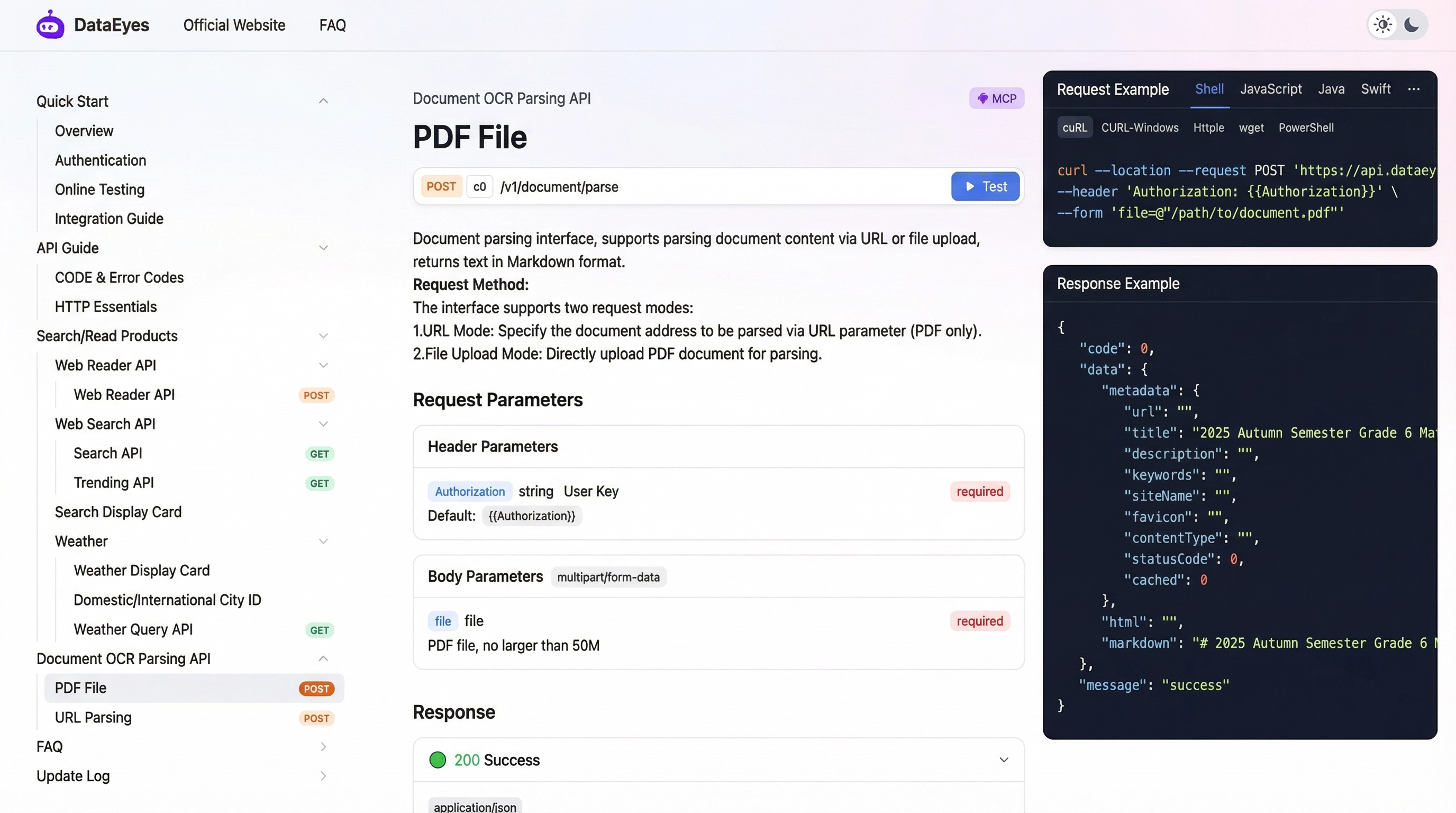
Find the "Document OCR Parsing API" section in the official documentation center, which provides complete interface descriptions, request parameters, and return examples. Use it directly online or, according to your development habits, use Postman, cURL, or any programming language's HTTP library to call our OCR API.
Step 3: Parse Results, Deploy in Applications
The API will return responses in JSON format. The parsed structured text will be clearly encapsulated in the markdown field, ready for direct extraction and use.
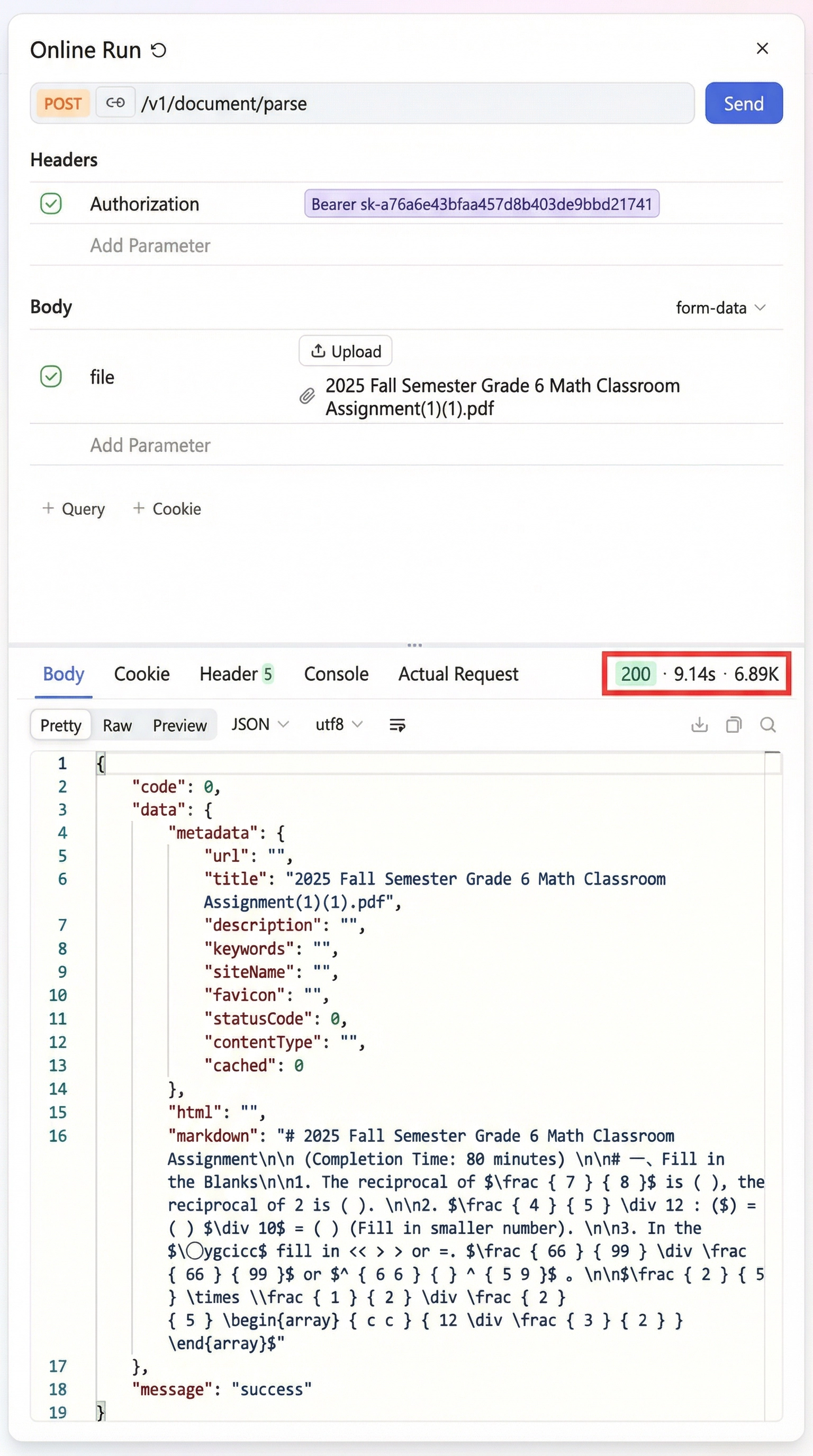
The entire call process can typically be completed within 10 seconds. For most standard documents, the response speed is more efficient compared to some large models on the market.
Through the above three steps, you can complete the entire process from document upload to obtaining structured data. Next, your business system can directly consume this high-quality Markdown data to drive automation workflows and in-depth analysis.
Use Cases
Through the above simple steps, DataEyesAI OCR API can penetrate multiple core business scenarios, solving long-standing information processing challenges:
Large Model Knowledge Base Construction (RAG)
For large model RAG (Retrieval-Augmented Generation) applications, precisely clean unstructured documents such as PDFs and Word files into Markdown or JSON formats. By faithfully preserving title hierarchies and paragraph logic, provide high-quality Clean Data for vector databases, significantly improving the accuracy and citation traceability of large model Q&A.
Intelligent Academic Literature Parsing
For documents containing numerous mathematical formulas and special symbols, such as papers, textbooks, and exam papers, achieve pixel-level precise restoration. Support direct translation of complex inline formulas and multi-line formulas into LaTeX/MathML code, facilitating secondary editing, translation, or construction of digital question banks by researchers and students, greatly reducing input time.
Financial Research Report Data Extraction
Automatically parse complex financial tables in prospectuses and annual financial reports. Intelligently recognize cross-page tables, borderless tables, and merged cell structures, extracting table data losslessly and exporting to Excel/CSV formats. Help financial analysts quickly structure key financial indicators, achieving automated data entry and quantitative analysis.
Enterprise Document Digitization and Archiving
Help governments and enterprises achieve digital transformation of massive paper archives. Support batch OCR recognition and concurrent processing of various layout documents such as contracts, bids, and invoices. Transform scanned documents and images into searchable dual-layer PDFs or plain text, breaking through enterprise internal knowledge silos and improving document circulation and management efficiency.
Conclusion
DataEyesAI OCR Document Parsing API, with its innovative "two-stage collaborative" architecture and core advantage of efficient response within 10 seconds, is becoming a key engine for enterprises to process unstructured information. By precisely outputting structured Markdown and JSON data, it directly empowers four core scenarios: providing high-quality data sources for large models (RAG), precisely restoring formula layouts for academic research, extracting complex table data for financial analysis, and achieving efficient batch processing for archive digitization.
This marks the starting point for documents moving from static storage to intelligent applications.
Experience now and open a new era of intelligent document processing.
You might also be interested
No related articles